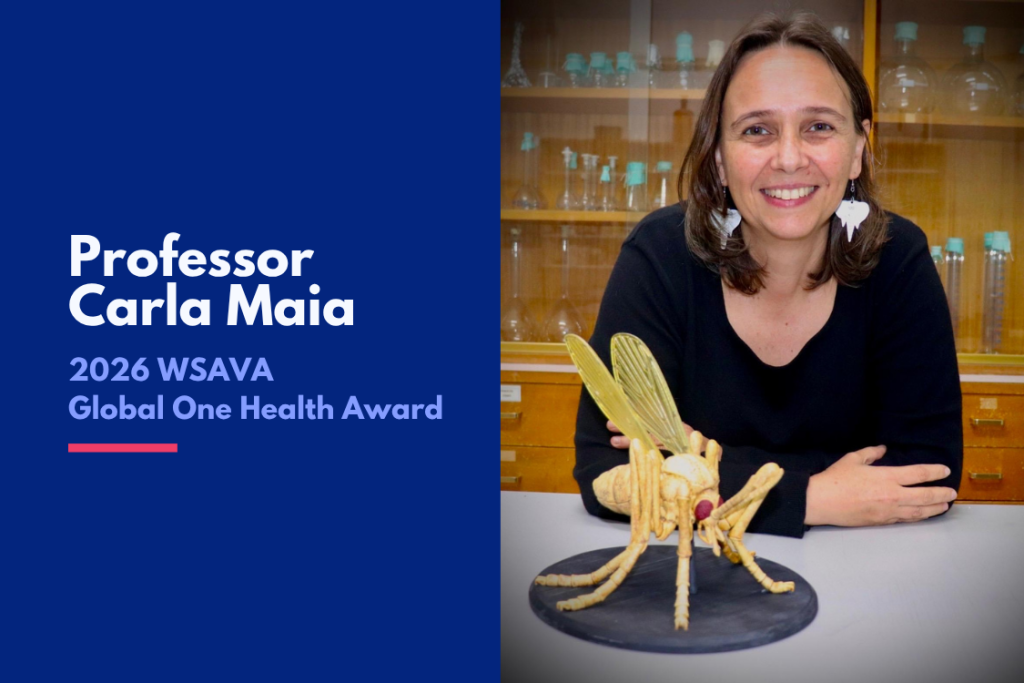
WSAVA is delighted to announce Professor Carla Maia of Portugal as the recipient of the 2026 WSAVA Global One Health Award, recognising her exceptional contribution to advancing the One Health approach and highlighting the essential role of companion animals within the interconnected health of animals, people and the environment.
Professor Maia is a veterinarian and Principal Researcher at the Institute of Hygiene and Tropical Medicine (IHMT), NOVA University Lisbon, where her work focuses on parasitology, vector-borne diseases and their implications for animal and human health. Her internationally recognised research into Leishmania and phlebotomine sand flies spans epidemiology, diagnosis, vector–pathogen–host interactions and disease transmission. More recently, her research has expanded to include phleboviruses and tick- and mosquito-borne agents of zoonotic and veterinary importance.
A central theme throughout her career has been understanding how changes in climate and the environment influence vector-borne diseases and their impact across species. As Principal Investigator at NOVA, she is involved in major European research initiatives including PLANET4HEALTH and ISMED-CLIM, building on her earlier leadership of CLIMOS. Through this work, she has helped ensure that companion animals are recognised as an important part of the One Health agenda, including their roles in zoonotic disease transmission and as sentinels of environmental and climatic change.
Professor Maia’s contribution extends well beyond research. Throughout her career, she has brought together veterinarians, scientists, public health professionals and experts from other disciplines, while helping translate scientific evidence into knowledge that can be applied in veterinary practice. She has also made a significant contribution to education and mentorship, supporting the development of the next generation of researchers and One Health professionals.
Reflecting on her contribution, Professor Manuel Magalhães-Sant’Ana, Professor of Animal Welfare and Veterinary Ethics at the University of Lisbon, described Professor Maia as combining “scientific excellence with an exceptional capacity to build bridges between research, public health, and veterinary policy.” He also highlighted her ability to ensure that “companion animals and veterinary expertise are fully integrated into discussions on climate change, vector-borne diseases, and environmental health.”
The Portuguese Association of Small Animal Veterinarians (APMVEAC) also highlighted the practical impact of her work, noting that she has consistently helped bring emerging evidence on vector-borne zoonoses “out of the laboratory and into the consulting room,” enabling companion animal clinicians to recognise, prevent and manage these diseases with greater confidence.
Commenting on the award, Professor Maia said: “I feel deeply honored to receive the 2026 WSAVA Global One Health Award, and I sincerely thank the selection committee for this recognition. It has been a great pleasure and privilege to work in the field of vector-borne diseases throughout my career. I see this award not only as a recognition of my work, but also as a tribute to all my colleagues, students, collaborators, partners and pet owners who have been part of this journey, as well as to the funding organisations that have supported our research.”
Professor Maia’s career demonstrates what One Health can achieve when scientific excellence is combined with collaboration, education and a commitment to translating knowledge into action. By connecting animal, human and environmental health — and ensuring companion animals remain an integral part of that conversation — her work continues to strengthen both veterinary medicine and the wider global One Health community.